EXPLORE SHARK CONSERVATION PROGRAMMES
Sharks are not the threat. They are the threatened. Despite occupying the top of the marine food chain for over 450 million years, shark populations worldwide have collapsed by more than 70% in the past 50 years. The primary driver is human activity — commercial fishing, finning, habitat destruction, and the slow erosion of the reef ecosystems that many shark species depend on. Without sharks, marine ecosystems unravel. They regulate prey populations, maintain the health of coral reefs, and underpin the biodiversity of the entire ocean food web.
Effective shark conservation requires data — on population sizes, movement patterns, habitat use, and the effectiveness of existing protection measures. Marine Impact’s shark conservation programmes place volunteers at the heart of that research, working alongside professional marine scientists in locations where great white sharks, reef sharks, and other species can be observed and studied in their natural environment.
What will you do?
Shark conservation fieldwork is demanding, exhilarating, and genuinely important. Depending on your programme and location, typical activities include:
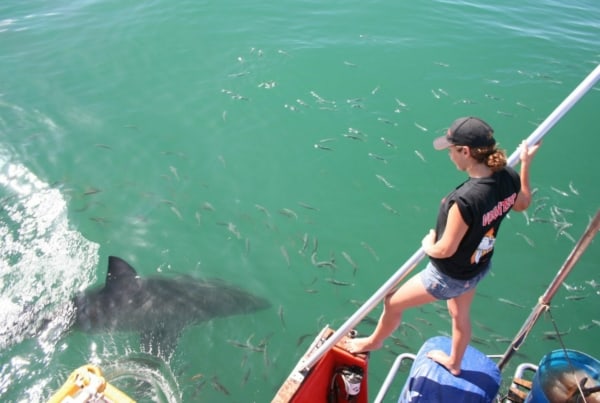
- Boat-based research expeditions to observe, photograph and record shark behaviour, size estimates, and species identification
- Photo-identification cataloguing — building population records from fin and marking photographs to track individual animals over time
- Underwater surveys of reef health and fish abundance to assess the broader ecosystem context of shark presence
- Bait and camera trap deployment to record species presence in areas not easily surveyed by dive
- Data analysis and database entry contributing to long-term population research
- Community and ecotourism education to build local support for shark protection
In South Africa’s Gansbaai — one of the highest-density great white shark habitats in the world — cage diving forms part of the research methodology, giving volunteers close-range observation opportunities that are both scientifically valuable and genuinely unforgettable. This is not a tourist excursion — every dive has a research purpose.
Where can I volunteer?
Our flagship shark conservation programme is based in Gansbaai, South Africa, widely regarded as the great white shark capital of the world. The cold, nutrient-rich waters of Walker Bay support one of the largest remaining great white populations on earth, and our research partner has been studying this population continuously for years, building one of the most comprehensive great white datasets in existence.
Additional shark research opportunities are available through our broader marine conservation programmes in Mozambique and the Cayman Islands, where reef shark species including bull, nurse, and Caribbean reef sharks are regularly encountered during survey dives.
Who is this for?
A passion for sharks and marine conservation is the most important qualification. Prior research experience is not required — full scientific training is provided. For programmes involving scuba diving, a PADI Open Water certification is required; this can be obtained locally before or during your programme if you don’t already hold one. Cage diving programmes in South Africa do not require diving certification.
These programmes attract a wide range of volunteers — from marine biology students seeking field research experience, to wildlife enthusiasts wanting to contribute to conservation in a meaningful way, to professionals using a career break to do something that matters.
Why Marine Impact?
Marine Impact was built on the principle that volunteer conservation programmes should produce real scientific outputs, not just memorable experiences. Our shark research is conducted in genuine partnership with established marine research institutions, and the data collected by volunteers feeds directly into peer-reviewed research and conservation policy. When you join a Marine Impact shark programme, you are not a tourist with a good story — you are a contributing member of a research team.