The first time you see a manta ray underwater, it takes a moment to process. They move differently from other large marine animals. Not the urgent power of a shark or the ponderous drift of a whale shark. Manta rays glide. Effortless, almost architectural, with wingspans that can reach seven metres. And they are curious. At the cleaning stations in the waters around Tofo, they circle. They come close. They look directly at you.
The Inhambane Peninsula in southern Mozambique is one of the most significant manta ray research sites in the Indian Ocean. Marine Impact’s Mozambique programme has catalogued over 1,000 individual manta rays in the area. For volunteers, manta ray research is one of the core fieldwork activities, conducted through scuba research dives at known cleaning stations and feeding areas year-round. Here is an honest account of what that research actually involves.
Why Inhambane is exceptional for manta ray research
Manta rays are not uniformly distributed around the world’s oceans. They aggregate in specific areas for specific reasons, and Inhambane is one of those areas. The combination of nutrient-rich currents, productive reef systems, and established cleaning stations creates conditions that attract both reef manta rays (Mobula alfredi) and oceanic manta rays (Mobula birostris) in unusually high numbers.
Cleaning stations are fixed points on the reef where small cleaner wrasse fish remove parasites and dead skin from larger animals. Manta rays return to the same stations repeatedly, hovering in the current in what researchers describe as a trance-like state while the cleaner fish work. This predictable behaviour is what makes photo-identification research possible, and it is what makes Inhambane so valuable. You know where to find them, and they will stay long enough to photograph.
Over 1,000 individuals have been catalogued in the Inhambane area over more than a decade of continuous monitoring. That population record is built from thousands of photo-ID images collected on research dives, many of them taken by volunteers. Each image adds to a dataset that tracks individual animals across years, links sightings in Mozambique to sightings elsewhere in the Indian Ocean, and builds a picture of population health, movement, and reproductive rates over time.
What manta ray research dives actually involve
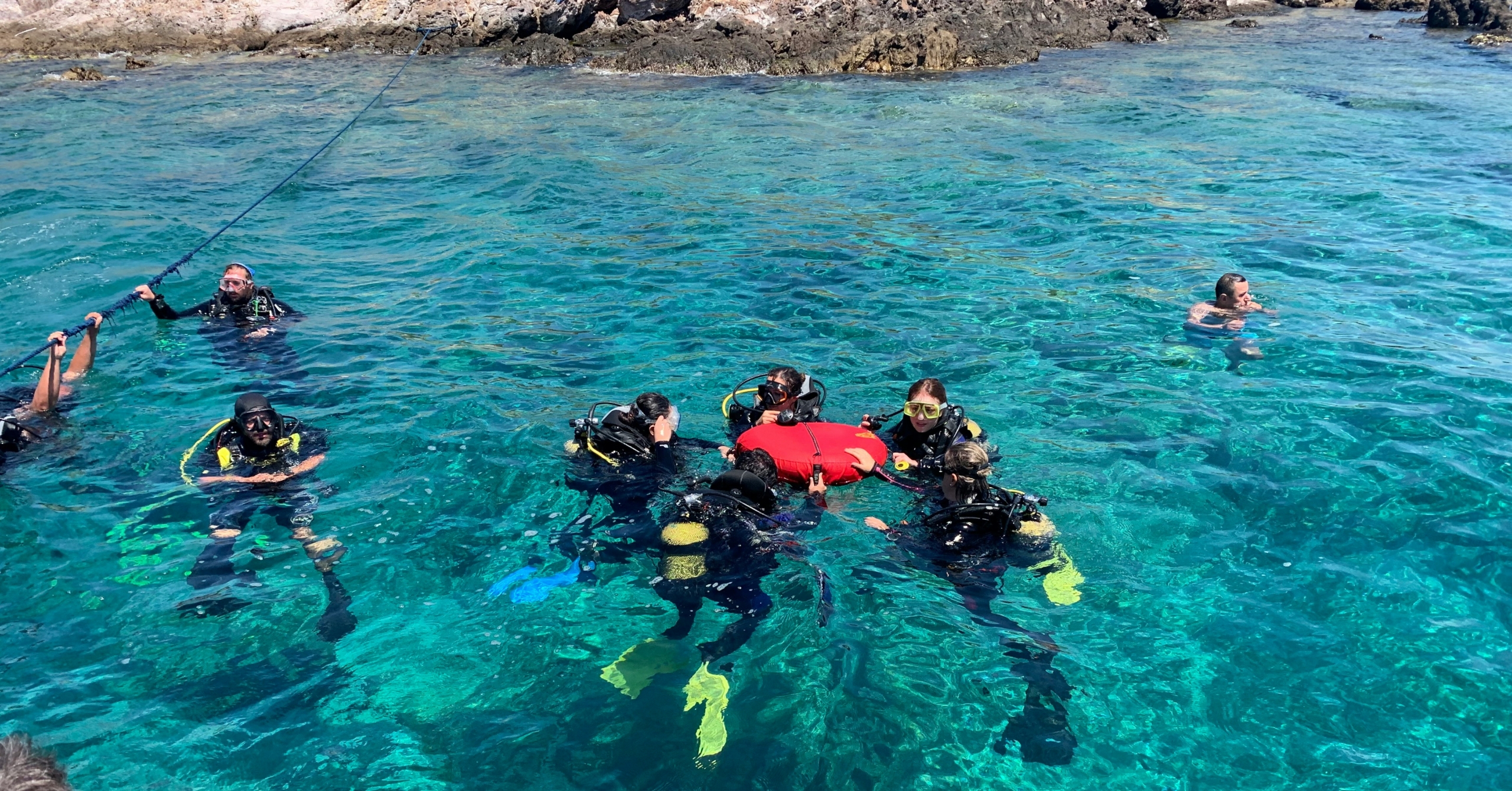
A manta ray research dive is a scuba dive with a specific scientific purpose. You are not free diving to observe whatever you happen to see. You are following a structured protocol, collecting defined data on defined species at defined sites.
Before your first research dive you will be trained in the identification methodology. The primary tool for individual manta ray identification is the pattern of spots on the ventral surface, the underside of the animal. These spot patterns are unique to each individual, like fingerprints. You will learn how to photograph them correctly: the angle, the positioning, what to capture to make the image useful for identification. You will also learn how to record additional data, the animal’s sex, behaviour, whether it shows signs of injury or entanglement, what it is doing at the cleaning station.
On the dive itself, the work is methodical. You approach slowly. You do not chase the animal or disrupt its behaviour. You position yourself to capture the ventral surface photograph. You record your observations. If the manta leaves, you note that. If others arrive, you repeat the process. The data from each dive is uploaded to the research database and cross-referenced against existing records. If you photograph an animal that has already been catalogued, that is a resighting. If the pattern does not match any existing record, you have identified a new individual.
It is absorbing work. Not because every dive produces dramatic footage, but because the research has a clear purpose and you can see how your contribution fits into something larger. The 1,000th manta ray in the Inhambane catalogue was not catalogued on a single dive by a single researcher. It was catalogued over years of patient, consistent field work by a research team and dozens of volunteers.
Reef manta vs oceanic manta: what you will encounter
Both species are present in the Inhambane area. Reef manta rays (Mobula alfredi) are the more commonly encountered species on cleaning station dives. They are smaller than oceanic mantas, with wingspans typically between three and four metres, and they tend to associate more closely with specific reef sites. The named individuals in the Inhambane catalogue are predominantly reef mantas because their site fidelity makes consistent resighting possible.
Oceanic manta rays (Mobula birostris) are the larger species, with wingspans reaching up to seven metres. They range more widely and appear less predictably at fixed sites, but they do appear in Inhambane waters, particularly around the deeper reef structures offshore. An encounter with an oceanic manta on a research dive is one of those moments that tends to produce the same response from every volunteer who experiences it: complete stillness, followed by a description that sounds inadequate.
Both species are listed as Vulnerable on the IUCN Red List. Both face ongoing pressure from targeted fisheries, bycatch, and the gill plate trade. The population data collected in Inhambane contributes directly to the global understanding of their conservation status.
The acoustic listening station work
Photo-identification tells you which individual animals are present and what they are doing at a specific site on a specific date. Acoustic tagging tells you where they go when they leave.
Some of the manta rays in the Inhambane catalogue carry acoustic tags, small transmitters attached to the animal by research divers. Acoustic listening stations, fixed underwater receivers, detect these tags when a tagged animal swims within range. The data from these receivers builds movement records for individual animals: which reef sites they visit, how frequently, in what sequence, and across what geographic range.
Volunteers contribute to this work by helping to service and download data from the listening stations on research dives. The movement data it generates is what allows researchers to understand not just which animals are in Inhambane, but how they use the broader Indian Ocean ecosystem.
When manta rays are most active in Inhambane
Manta rays are present in the Inhambane area year-round. But their activity and abundance shifts with the seasons. The peak period for manta ray encounters is roughly May to December, driven by the productivity cycles of the Indian Ocean. During these months the nutrient-rich conditions that manta rays depend on for filter feeding are at their strongest, and aggregations at cleaning stations and feeding areas are more frequent and more predictable.
Outside peak months, particularly January to April, mantas are still present and research dives still produce encounters. But the density is lower and the window to find animals at cleaning stations can be shorter. If manta ray research is your primary reason for coming to Mozambique, May to December is the period to aim for.
Do I need advanced diving experience?
A PADI Open Water certification is the minimum requirement for manta ray research dives. If you do not hold one, it can be arranged at the dive centre in Tofo before your placement begins. Research dives typically take place at depths between 10 and 25 metres, within comfortable range for Open Water certified divers.
More experienced divers will find the programme extends naturally into more complex survey work. Some placements include SDI Research Diver certification as part of the programme. Advanced divers and those completing internships tend to take on more independent survey responsibilities as their placement progresses.
What matters more than dive certification level is attention to detail and patience. Manta ray research requires careful observation, methodical data collection, and the discipline not to disturb the animals you are studying. These are skills that can be learned.
What else you will research alongside the mantas
Manta ray research dives are conducted alongside a full programme of fieldwork. The same days that produce manta ray encounters also produce coral reef transect data, indicator fish counts, and observations of the wider reef ecosystem. Other days focus on whale shark ocean safaris, humpback whale surveys (June to October), dolphin monitoring, sea turtle beach surveys, and estuary work.
The breadth of the research programme is one of the things that distinguishes the Mozambique placement from more narrowly focused marine volunteer projects. You are not just collecting manta ray data. You are contributing to a long-term, multi-species monitoring programme at Africa’s first permanent marine observatory. The manta ray dataset is one part of a larger picture of ecosystem health that the research team has been building for more than a decade.
Is this the right project for you?
Manta ray research in Mozambique is genuinely exceptional. The population is large, the encounter rates are high by global standards, and the research methodology is rigorous. But it is fieldwork. There are days when the cleaning stations are quiet, when dives produce less than you hoped, when the data entry takes longer than the diving. The volunteers who get the most from this programme are those who come for the research as much as for the encounters, because the research is what makes the encounters meaningful.
If that sounds like you, get in touch and tell us when you are thinking of going and what diving qualification you hold. We will help you work out whether this placement is the right fit and what to expect when you arrive.
You can also browse all our Mozambique programmes or read our honest guide to volunteering with whale sharks in Mozambique to understand the full picture of what the Tofo programme involves.