
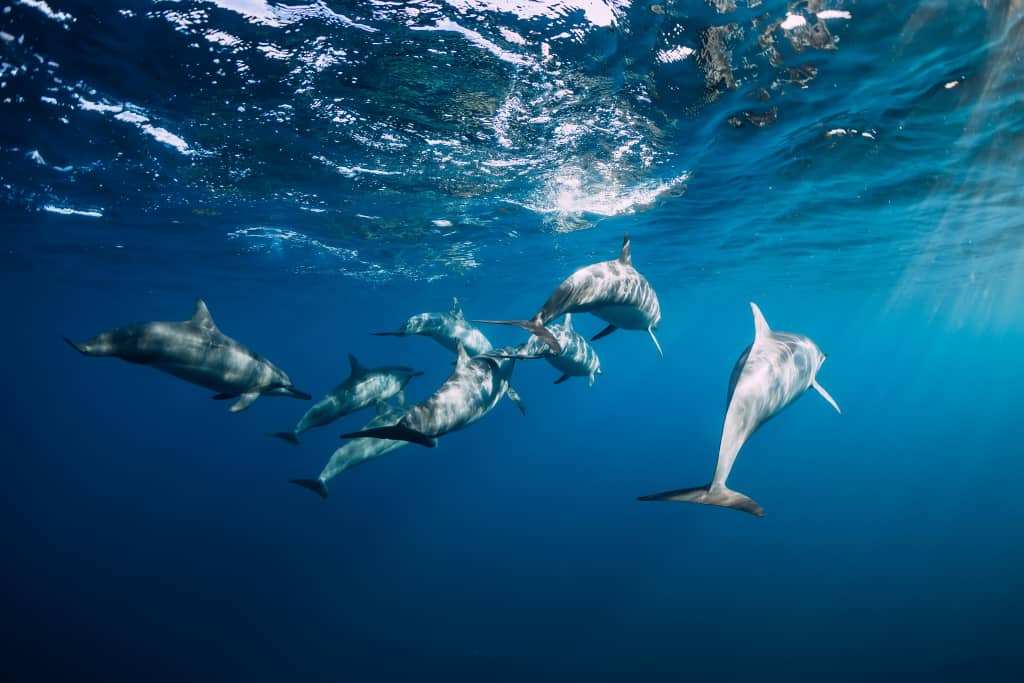
Most people who sign up for Marine Impact’s Zanzibar programme picture one moment. A dorsal fin breaking the surface, a boat cutting its engine, a pod moving past close enough to count. That moment happens often here. But it is not the point of the programme. The point is what happens after the boat comes back in.
Turning a sighting into a record
Every dolphin encounter gets logged the same way. Volunteers record group size, behaviour and movement, then photograph dorsal fins, which carry nicks and marks as individual as a fingerprint. Those photographs go into a catalogue that researchers use to identify specific animals across years, not just across a single trip. A dolphin photographed in 2019 can be matched against one photographed last week. That match is what turns a good afternoon on the water into a usable data point.
Watching the watchers
Zanzibar’s dolphin population in Menai Bay draws its own tourism industry, and that industry can be part of the problem. Boats that crowd pods, cut engines too close, or chase animals for a better photo change dolphin behaviour over time. Volunteers monitor these human dolphin interactions directly, recording boat numbers, distances and how pods respond. That record is not decoration. It has been used to inform how tourism in the bay is managed.
Listening as well as watching
Not every part of the research happens above the surface. Acoustic monitoring records dolphin communication, including how it changes when boat traffic is heavy. Engine noise travels far underwater and can interfere with the clicks and whistles dolphins use to coordinate, hunt and stay in contact with their pod. A quiet recording session on a slow tourism day and a noisy one on a busy weekend can look like two different soundscapes entirely, and comparing them over time builds a picture of how much pressure the local tourism industry is putting on the pods that live here year round.
Who actually reads this data
The Zanzibar programme has run continuously since 2013 in partnership with the University of Dar es Salaam. That partnership matters more than it sounds. A single season of dolphin sightings tells you almost nothing. Over a decade tells you whether a population is stable, whether calving patterns are shifting, and whether tourism pressure is having a measurable effect. Researchers and government agencies use that longer record to shape real conservation decisions for Menai Bay, not just to publish a paper and move on.
Reef surveys feed the same picture
Dolphins are not the only thing recorded. Coral reef health surveys run alongside the dolphin work, tracking coral cover, fish abundance and the condition of the reef the dolphins and everything else in the bay depend on. Together the two datasets give researchers a fuller picture of how the ecosystem is holding up under pressure from tourism, fishing and warming water.
Why this changes what a placement actually is
Joining as a volunteer means becoming part of that decade plus record rather than starting something new. The data you collect in your first week gets compared against data from a volunteer who ran the same survey five years ago, using the same methodology, in the same bay. That consistency is what makes the dataset valuable, and it is also why training at the start of a placement matters so much. You are not improvising a method. You are following one that has already proven itself over years of use.
Marine Impact’s dolphin research and marine conservation programme runs from Kizimkazi and Jambiani on Zanzibar’s south coast, inside the Menai Bay Conservation Area. If you want to see where your data would actually go before you commit to a placement, get in touch and we can walk you through it.